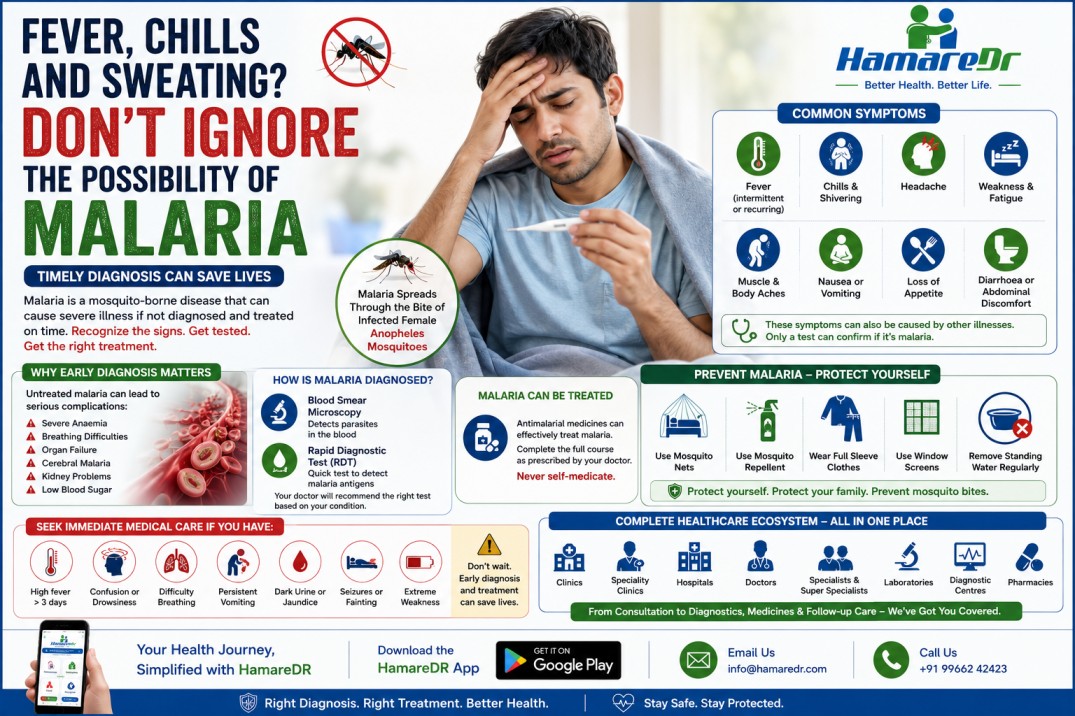
A sudden fever accompanied by chills, sweating, headache, body aches or unusual weakness may sometimes indicate malaria. Learn how malaria spreads, the symptoms to watch for, why testing matters, how it is treated, and practical ways to protect yourself and your family from mosquito bites.
Fever With Chills? Your Body May Be Telling You More Than You Think ?
Did your fever begin suddenly?
Are you experiencing intense chills or shivering, followed by fever and sweating?
Do you have a headache, body aches or unusual weakness?
Are you feeling nauseous or generally unwell?
It can be easy to label these symptoms as “viral fever” and wait for them to disappear. But fever can have many different causes. One of them is malaria, a potentially serious mosquito-borne disease that requires proper diagnosis and treatment. The important question isn't simply:
“How do I bring my fever down?”
“What is causing my fever?”
What Is Malaria?
Malaria is an infectious disease caused by Plasmodium parasites. These parasites are transmitted to humans primarily through the bite of an infected female Anopheles mosquito. After entering the body, the parasites first travel to the liver and later infect red blood cells. Different species of Plasmodium can cause malaria in humans, including Plasmodium falciparum and Plasmodium vivax. Some forms of malaria can progress rapidly and cause severe illness. That's why suspected malaria shouldn't be diagnosed or treated based on symptoms alone.
Malaria is different from infections such as the common cold or influenza. It does not normally spread through everyday casual contact with someone who has malaria. The main transmission cycle involves:
Infected person → Mosquito → Another person
A mosquito bites someone carrying malaria parasites. The mosquito becomes infected. Later, that infected mosquito bites another person and can transmit the parasites. Preventing mosquito bites and reducing mosquito breeding therefore play important roles in controlling malaria.
Malaria symptoms can vary depending on the parasite involved and the individual. Common symptoms can include:
Fever : Fever is one of the most common signs of malaria and may occur intermittently or follow particular patterns. Chills and Shivering Some people experience episodes of intense chills or shaking.
Sweating : Heavy sweating may occur, sometimes following an episode of fever and chills.
Headache : Headaches can accompany the fever. Muscle and Body Aches Malaria can cause general body pain and discomfort. Weakness and Fatigue The infection can leave you feeling extremely tired or weak.
Nausea or Vomiting : Some patients experience digestive symptoms alongside fever. These symptoms can overlap with several other illnesses. Malaria cannot reliably be diagnosed simply by recognizing a particular combination of symptoms.
This is where fever can become confusing. Imagine someone develops:
Fever + headache + body aches + weakness.
Could it be malaria?
Yes.
Could it be dengue?
Possibly.
Could it be typhoid?
Possibly.
Could it be influenza or another viral infection?
Also possible. Symptoms alone may not provide the answer. And treatments can be completely different depending on the cause. That's why persistent, recurring or severe fever should be medically evaluated rather than self-diagnosed.
“I Had Malaria Before — I Know What It Feels Like.”
Previous experience doesn't guarantee that a new fever has the same cause. Even if today's symptoms feel identical to a previous malaria infection, testing may still be necessary. Taking antimalarial medicines without confirming the diagnosis can expose you to unnecessary medication, delay identification of another illness and contribute to inappropriate medicine use. Past malaria does not automatically mean today's fever is malaria. Let a qualified healthcare professional assess the current illness.
If malaria is suspected, a healthcare professional may recommend testing to identify malaria parasites. Common diagnostic approaches include: Blood Smear Microscopy, A blood sample is examined under a microscope to look for malaria parasites. This can also help determine the parasite species and assess the level of infection in appropriate settings. Rapid Diagnostic Tests Malaria rapid diagnostic tests can detect certain parasite antigens in the blood and provide results relatively quickly. Your doctor or laboratory professional will determine the appropriate test depending on the clinical situation. Sometimes repeat testing or additional investigations may be required when symptoms persist.
Malaria can range from a relatively uncomplicated illness to a severe, potentially life threatening disease. Certain forms, particularly malaria caused by P. falciparum, can progress quickly. Severe malaria may affect vital organs and can cause complications such as:
Severe anemia
Low blood sugar
Breathing difficulties
Kidney problems
Neurological complications
Altered consciousness
Seizures
Organ failure
Early diagnosis allows appropriate treatment to begin sooner. Don't wait for a fever to become severe before seeking medical advice.
Malaria is treated using antimalarial medicines. However, there isn't one treatment that should automatically be used for every patient. Treatment can depend on factors such as:
The malaria parasite involved • Severity of illness • Local drug-resistance patterns • Patient's age and health • Pregnancy status • Previous treatment
Some types of malaria can also remain dormant in the liver and may require additional treatment to reduce the risk of recurrence. For these reasons: Never self-prescribe antimalarial medicines. A qualified healthcare professional should determine the appropriate treatment.
Malaria can become serious in anyone, but certain groups may be particularly vulnerable. These can include:
Young children
Pregnant women
Older adults
People with weakened immune systems
People without previous malaria exposure
Patients who delay appropriate treatment
If someone in a higher-risk group develops a significant fever after possible mosquito exposure, medical evaluation is particularly important.
Seek prompt medical care if fever is persistent, recurring, severe or accompanied by concerning symptoms. Urgent medical attention may be necessary if someone develops:
Difficulty breathing • Confusion • Extreme drowsiness • Seizures • Persistent vomiting • Severe weakness • Fainting • Yellowing of the eyes or skin • Dark urine • Inability to drink fluids
Severe illness should not be managed solely through an online consultation or self medication. The Best Malaria Strategy? Prevent the Mosquito Bite. Reducing mosquito exposure can lower your risk. Use Mosquito Nets , Sleeping under an appropriate mosquito net can help reduce night time mosquito bites. Use Suitable Mosquito Repellent , Apply mosquito repellent according to the product instructions.
Cover Exposed Skin : Long sleeves and trousers can help reduce exposed skin, particularly when mosquito activity is high. Use Screens Where Possible Window and door screens can help prevent mosquitoes from entering living spaces.
Don't Allow Water to Accumulate : Mosquitoes breed in water. Regularly check areas around your home for unnecessary standing water, including:
Buckets • Containers • Coolers • Flower pots • Discarded tyres • Open tanks
Empty, clean, cover or appropriately manage containers that can collect water. Hyderabad's Monsoon? Make Mosquito Prevention a Habit Periods of rainfall can create additional opportunities for water to collect around homes, buildings and neighborhoods. Even small collections of stagnant water can become mosquito breeding sites. Instead of thinking about mosquito control only after someone develops a fever, make it part of your regular household routine. Check. Empty. Cover. Clean. Repeat. And remember: different mosquito-borne diseases can be transmitted by different mosquito species and at different times of day. Protection shouldn't be limited to nighttime alone. Don't Just Treat the Fever. Find the Cause. Fever-reducing medicines may temporarily make you feel better. But they don't tell you whether the underlying cause is:
Malaria • Dengue • Typhoid • Influenza • Another infection
If your fever persists or is accompanied by chills, significant weakness or other concerning symptoms, medical evaluation and appropriate diagnostic testing can help determine what is actually happening.
Right diagnosis → Right treatment → Better chance of timely recovery.
Fever to Diagnosis to Treatment — Find Healthcare Support with HamareDR , When fever needs medical attention, the patient journey can involve several different healthcare services. You may need a doctor or clinic for an initial consultation, a laboratory or diagnostic Centre for testing, a pharmacy for prescribed medicines, or a hospital or specialist if the illness is severe.
HamareDR brings healthcare providers together within one ecosystem, helping patients discover and access:
Clinics • Specialty Clinics • Hospitals • Doctors • Specialists • Super Specialists • Pharmacies • Laboratories • Diagnostic Centers
Whether you need medical evaluation for a persistent fever, prescribed malaria testing or further healthcare support, find the appropriate healthcare services through HamareDR.
Download the HamareDR Android App: Download on Google Play
Email: info@hamaredr.com
Call: +91 99662 42423
Fever + Chills? Don't Guess. Recognize the symptoms. Get tested when advised. Get the right treatment. Protect yourself from mosquito bites.
This article is intended for general health awareness and educational purposes only and is not a substitute for professional medical advice, diagnosis or treatment. If you have persistent or severe fever or other concerning symptoms, consult a qualified healthcare professional promptly.